The Formosan termite — Mobile’s million-strong houseguest.
One call reaches a licensed, local exterminator who covers your address — and a real person answers, 24/7.
Free to check coverage — the operator gives the quote after inspecting.
Check your ZIP first
One call reaches a licensed, local exterminator who covers your address — and a real person answers, 24/7.
Free to use · No obligation to hire anyone
Status in Mobile-Baldwin: established, expanding, permanent
Scientific name: Coptotermes formosanus. Family: Rhinotermitidae. Status: established invasive species, confirmed throughout Mobile and Baldwin Counties and continuing to expand its range by an estimated mile per year.
Formosan termites were first confirmed in Mobile County in the 1960s — among the earliest U.S. detections — after hitching through the Gulf ports in infested materials. Auburn ACES surveillance and Louisiana State University AgCenter mapping document continuous establishment across Mobile County (Midtown, Spring Hill, West Mobile, Prichard, Saraland, Chickasaw, Semmes) and across Baldwin County (Daphne, Fairhope, Spanish Fort, Foley, Gulf Shores, Orange Beach, Bay Minette). The warm, wet Gulf climate is ideal for them, and normal Mobile winters do not slow colony growth.
What makes the species categorically different isn’t venom or speed — it’s scale. A mature native Eastern subterranean colony holds a few hundred thousand termites. A mature Formosan colony holds one to ten million, forages up to 300 feet from the central nest — the longest reach of any Alabama termite — and can do in two years the structural damage a native colony does in eight.
Dusk swarm around the porch light in May or June? Assume Formosan until proven otherwise.
Native subterraneans swarm in daylight, late winter into spring. Formosans swarm at dusk on warm, humid May and June evenings, in large numbers, around lights. An indoor swarm means a colony in or very near the structure. Leave the wings where they fall — they’re how the operator confirms species — and get connected below.
Free to check coverage. ADAI-licensed operators serving Mobile & Baldwin County, AL.
Identification — the soldier’s head settles it
Workers are indistinguishable without a hand lens. Soldiers and swarmers tell the story.
Workers
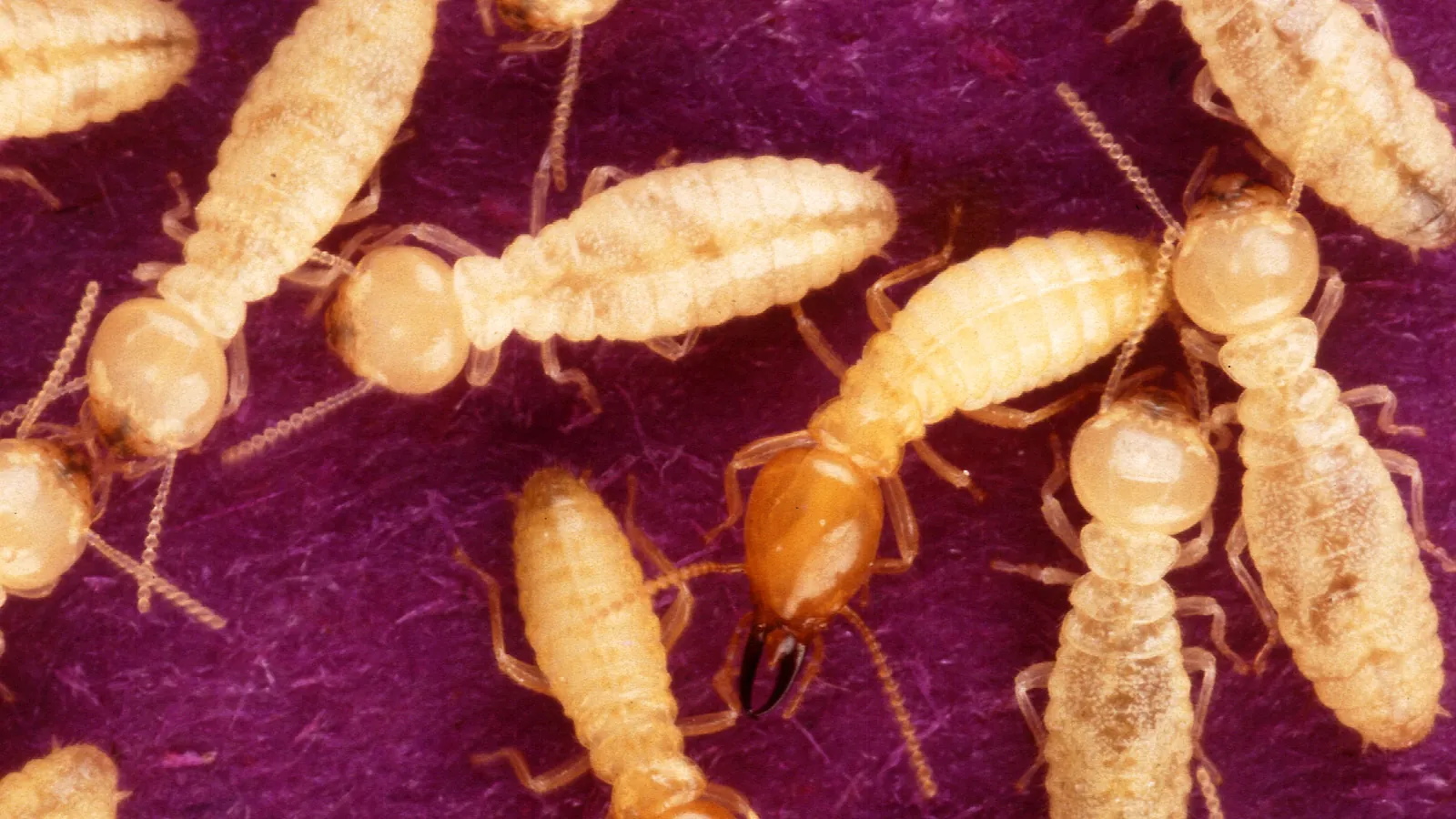
About 1/8 inch, translucent cream, visually identical to native subterranean workers. If all you’ve found is workers in wood, species ID waits for a soldier or a swarmer — don’t let anyone quote a treatment off workers alone.
Soldiers
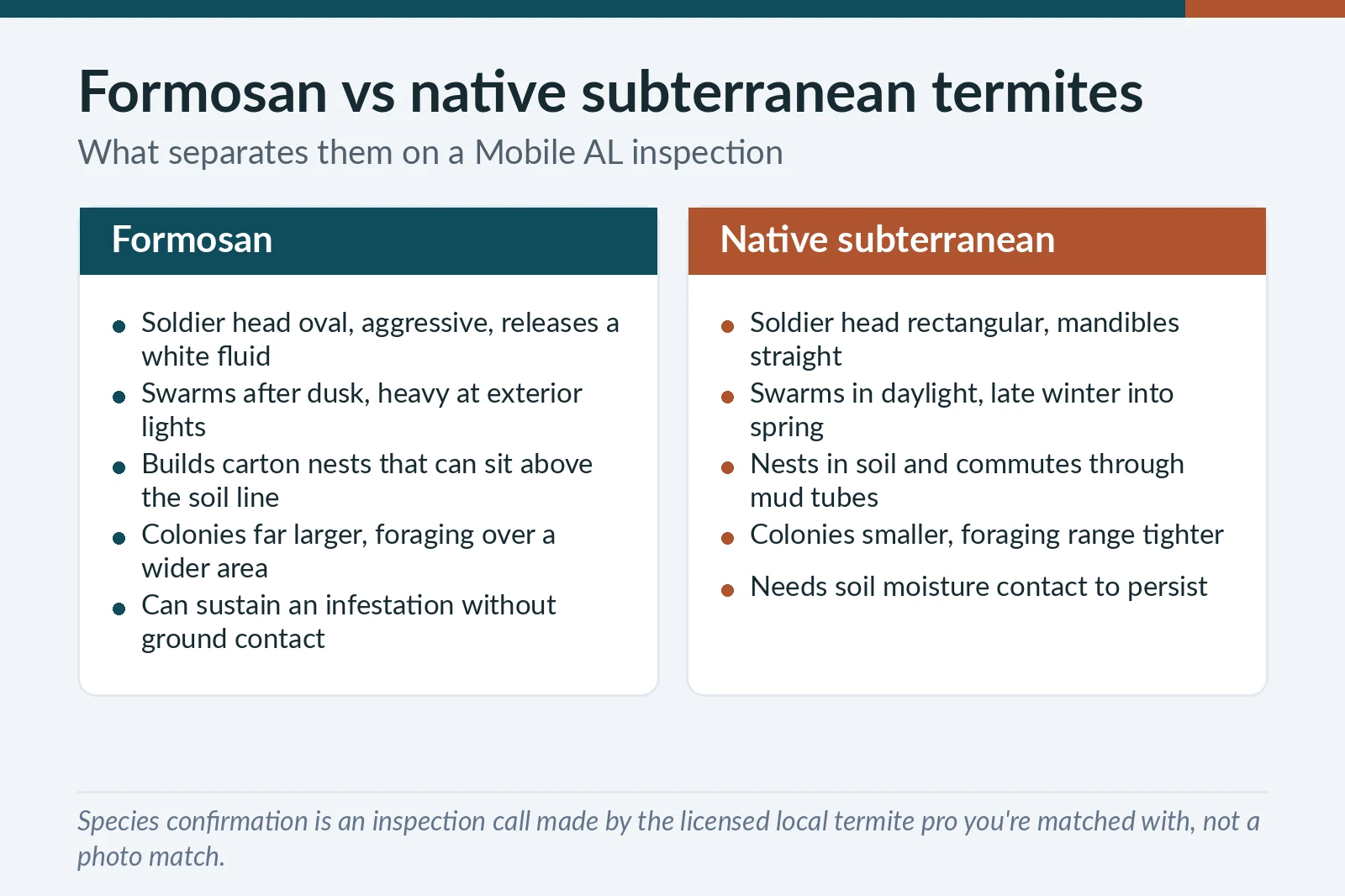
The field ID. Formosan soldiers have an oval, teardrop-shaped head and exude a milky defensive secretion from the forehead when disturbed. Native soldiers have a rectangular head. Formosan colonies also field proportionally more soldiers — disturb a tube and many defenders pour out fast.
Swarmers
Roughly 1/2 inch including wings, yellowish-brown, with hairy wings. They fly at dusk in May–June, drawn hard to lights, and shed four equal-length wings after landing. Native swarmers are darker, smaller, and fly in daytime earlier in the year.
The carton nest — why Formosans break the normal termite rules
Every homeowner rule of thumb about subterranean termites — “they have to return to soil,” “a treated soil barrier protects the house,” “check the foundation and you’ve checked for termites” — has a Formosan asterisk, and the asterisk is the carton nest.
Formosan colonies build sponge-like nests of chewed wood, soil, saliva, and droppings that hold their own moisture. Once a carton nest is established inside a wall cavity, an attic, or a flat roof assembly, the colony no longer needs daily soil contact. That’s how Formosans colonize second stories, roof eaves, and even boats and rail cars — places a native colony can’t sustain itself.
The operational consequences for a Mobile home:
- A clean slab edge doesn’t clear the house. Aerial infestations start where moisture persists above grade — a leaking flat roof, a chronically wet wall cavity, a clogged gutter line feeding a fascia board.
- A soil treatment alone may not reach the colony. Liquid termiticide in the soil intercepts foragers commuting from below — it does nothing to a self-sufficient nest already in the attic. This is why species confirmation changes the method conversation.
- Moisture control is termite control. Fixing the roof leak and the gutter line removes the water budget an aerial nest depends on. Expect a good operator to talk about your roof as much as your slab.
A single colony’s numbers explain the damage rate: LSU AgCenter case studies have documented complete sill-plate failure in under 18 months. And a fact worth planning around: homeowner insurance does not cover termite damage in Alabama. The economics of early detection are lopsided in your favor.
What a licensed operator will actually do
Educational only — the independent operator recommends and performs all work, and every structure is different.
Confirm the species
Soldier head shape, swarmer wings, gallery carton. Formosan vs. native changes the method, the product class, the monitoring plan, and the budget — which is why it’s step one, not a formality.
Map the moisture
Roof, gutters, flashing, bath and kitchen plumbing, crawl-space humidity. For Formosans this is diagnostic — an aerial nest needs a water source, and finding it often finds the nest.
Choose the method
Non-repellent liquid soil treatment, in-ground bait systems (Sentricon-class), direct treatment of accessible nests, or a combination. The operator explains why for your structure — foundation type, moisture picture, and species drive it.
Two Mobile-specific notes worth knowing before that conversation. First, ask what the termite bond covers — retreat-only versus repair — because in Formosan country the difference matters enormously; get renewal price and transferability in writing. Second, if a real-estate closing is involved, the WDO inspection / Section 1 letter is its own process with its own timeline — mention the closing date when you call.
The Formosan year on the Gulf Coast
| Season | What the colony is doing |
|---|---|
| Jan–Apr | Feeding continues — Gulf winters don’t pause Formosan colonies. Native subterranean swarms (daytime) start in late winter; any dusk swarm this early deserves a skeptical second look. |
| May–Jun | Peak Formosan swarm season: massive dusk flights on warm, humid evenings, concentrated around street lights, porch lights, and windows. Peak season for indoor swarm discoveries. |
| Jul–Sep | New colonies from successful pairings establish and grow; existing colonies feed at maximum rate; hurricane-season roof damage opens new moisture paths that aerial nests exploit. |
| Oct–Dec | Foraging continues below and above grade. This is prime inspection season — cooler weather, dry crawl spaces, and time to plan treatment before the next swarm cycle. |
Free to check coverage. ADAI-licensed operators serving Mobile & Baldwin County, AL.
Formosan termites — what do homeowners ask?
Are you a termite company?
No — Mobile Alabama Exterminators is a free dispatch and referral service. We connect Mobile and Baldwin County callers with independent, ADAI-licensed termite operators who perform every inspection and treatment. We suggest verifying any operator’s license with the Alabama Department of Agriculture & Industries’ Pesticide Management Section at (334) 240-7240 before hiring.
How do I tell Formosan termites from native termites?
Three field cues: soldiers with an oval teardrop head that release a milky secretion (native soldiers have rectangular heads); yellowish-brown swarmers flying at dusk in May–June around lights (natives are darker and fly in daytime, earlier in spring); and carton material packed into galleries. A licensed operator confirms under magnification.
Are Formosan termites really more destructive?
Yes — by colony scale, not by individual appetite. Mature colonies run one to ten million termites versus a few hundred thousand for natives, forage up to 300 feet, and can compress into two years the damage a native colony does in eight. Documented cases include sill-plate failure in under 18 months.
My house has a treated soil barrier — am I safe from Formosans?
Safer, not safe. Soil treatments intercept foragers commuting from underground, but Formosan carton nests can sustain a colony above grade wherever structural moisture persists — roof leaks, wet wall cavities, clogged gutters. Pair the soil program with moisture control and periodic inspection of the upper structure.
Does homeowner insurance cover Formosan damage in Alabama?
No — termite damage is excluded from standard homeowner policies in Alabama regardless of species. Prevention, early detection, and understanding exactly what a termite bond covers (retreat-only vs. repair) are the financial protections that actually exist.
I found a dusk swarm indoors — how fast should I act?
Promptly — an indoor dusk swarm in May or June means a mature colony in or immediately adjacent to the structure. Leave the shed wings in place for species ID, photograph everything, and get an inspection scheduled. The dispatch line processes requests 24/7; the operator sets their own timing with you.
A million termites work around the clock. So does the line.
Free to check coverage, free to get matched, no obligation. The licensed operator inspects and gives the quote.
Free to check coverage. ADAI-licensed operators serving Mobile & Baldwin County, AL.
Prefer to send details first? Use the contact form →