Termite swarming season in Alabama — read the wings before you panic.
Every spring, Mobile porches and windowsills collect little piles of shed wings. Some belong to harmless ants. Some mean a mature termite colony has been feeding nearby for years. This free 24/7 dispatch line connects you with an independent, ADAI-licensed termite operator who works your part of town — they inspect, they quote, they treat. You decide. Availability varies by operator schedule.
Free to check coverage. ADAI-licensed operators serving Mobile & Baldwin County, AL.
Free call, free match — the operator gives the quote. Availability varies by schedule.
Check your ZIP first
Enter your Mobile or Baldwin County ZIP to confirm coverage, then tap to call.
Free to use · No obligation to hire anyone
24/7 dispatch line — operator availability varies
Free call — the operator gives the quote
Mobile & Baldwin County coverage
The Alabama termite year — three swarms, three different stories
Mobile doesn’t really have a termite season. It has three of them, stacked back to back from late winter into early fall. The International Residential Code puts the Gulf Coast corridor in its heaviest termite probability zone — “very heavy” — and anyone who has lived through a May evening in Midtown when the streetlights fill with pale wings knows the code map isn’t exaggerating.
Here’s how the year actually unfolds on the ground in Mobile and across the Bay in Baldwin County:
- February through April — native Eastern subterranean swarms. These are the early birds. On the first warm, still afternoons after a rain, dark-bodied swarmers boil up out of the soil in daylight — off stumps, landscape timbers, and sometimes straight out of a baseboard or tub surround. A sunny 75-degree Saturday after a Friday soaker is classic swarm weather in Spring Hill and West Mobile.
- May through June — Formosan swarm season, Mobile’s signature event. Formosan subterranean termites came through the port decades ago and settled in hard. They swarm at dusk, in huge numbers, and they steer toward light — porch fixtures, ballfield banks, gas-station canopies, the glow behind your blinds. On the right humid, windless evening, whole neighborhoods from Oakleigh to Tillman’s Corner watch it happen at once. Formosan colonies run into the millions of individuals, several times the size of native colonies, which is why the operators here take a May swarm on a house seriously.
- Late summer — drywood termite flights. Smaller, quieter night swarms, usually July into September. Drywood termites don’t need soil contact; they set up in attic framing, eaves, and furniture. Fewer wings, easier to miss, and a completely different treatment conversation than the subterranean species.
Why the calendar matters: a swarm is not a random bug event. Swarmers are the winged reproductives a colony releases only after it has matured — which typically means the parent colony has been feeding on wood somewhere nearby for years before you saw a single wing. The swarm is the announcement, not the beginning.
One practical note from every swarm season on record: when the Formosans fly, the phone lines fill up. Termite operators across Mobile County book solid within days of the first big dusk flight. If you saw swarmers in February or March, calling then — instead of waiting for the May rush — usually means a faster appointment and a calmer conversation. Timing is always set by the operator and varies with their schedule.
Did a swarm just happen inside your house? Don’t vacuum up every trace. Keep a few insects or wings (tape them to an index card or drop them in a zip-top bag), take photos with something for scale, and note the room, the date, and the weather. That evidence tells the operator which species they’re dealing with before they even arrive.
Free to check coverage. ADAI-licensed operators serving Mobile & Baldwin County, AL.
How does the dispatch line work?
Total transparency: we answer phones and match. Licensed operators do the work.
You reach out, we listen
Reach out any hour. Give us your ZIP and describe what you saw — “wings on the kitchen windowsill” or “swarmers coming out of the wall at dusk” beats “bugs.” The call takes about a minute, costs nothing, and carries no obligation.
We match you locally
Mobile Alabama Exterminators is a dispatch and referral service, not a pest control company. Your call routes to an independent operator licensed by the Alabama Department of Agriculture & Industries who covers your part of Mobile or Baldwin County.
The operator takes over
The licensed operator inspects, identifies the species, explains the evidence, and gives you their own quote. Hiring them is entirely your decision — and you can verify their ADAI license first through the Pesticide Management Section in Montgomery at (334) 240-7240.
Indoors or outdoors — what a swarm is actually telling you
Same wings, very different messages. Location is everything.
A swarm inside the house is the serious signal. Swarmers emerging from a baseboard, a window frame, a bathroom wall, or the gap around a tub almost always mean the colony is in or directly under the structure. Termites emerging indoors are trying to get outside to mate — they came from somewhere inside your walls or slab. That’s the call to make the same day you see it.
A swarm outdoors is a nearby-colony notice, not a verdict. Swarmers rising off a stump, a woodpile, or the flowerbed mulch mean a mature colony lives within a short distance — sometimes in the yard, sometimes under the neighbor’s shed. Your house isn’t necessarily infested, but on the central Gulf Coast, “a mature colony within fifty feet” is exactly the situation a licensed operator should evaluate before spring turns to summer. In the meantime, our free Home Pest Prevention Checklist covers the yard-clutter and moisture fixes that reduce colony pressure near the house.
Wings on windowsills count as evidence even weeks later. Swarms are short — often twenty minutes — and they happen while you’re at work. What’s left behind is a scatter of shed wings on sills, in spiderwebs, in the garage door track. Don’t sweep them all away: termite wings are evidence an operator can read at a glance. Leave a few where they are, photograph the scatter, and save a pinch in a bag.
And before you call anyone, run the three-point check that separates termite swarmers from winged ants — carpenter ants fly here all summer and get misreported constantly:
- Waist. Termite swarmers are thick-bodied straight through, like a grain of rice. Winged ants have a pinched, hourglass waist.
- Wings. Termites carry four wings of equal length, longer than the body, and they shed them easily — that’s why you find wings without insects. Ant forewings are visibly longer than their hindwings, and they stay attached.
- Antennae. Termite antennae are straight strings of beads. Ant antennae bend at an elbow.
Color helps too: native subterranean swarmers are dark brown to black; Formosan swarmers are a pale yellow-brown and fly at dusk. If your photos show pale swarmers around a porch light in late May, the operator already knows half the story.
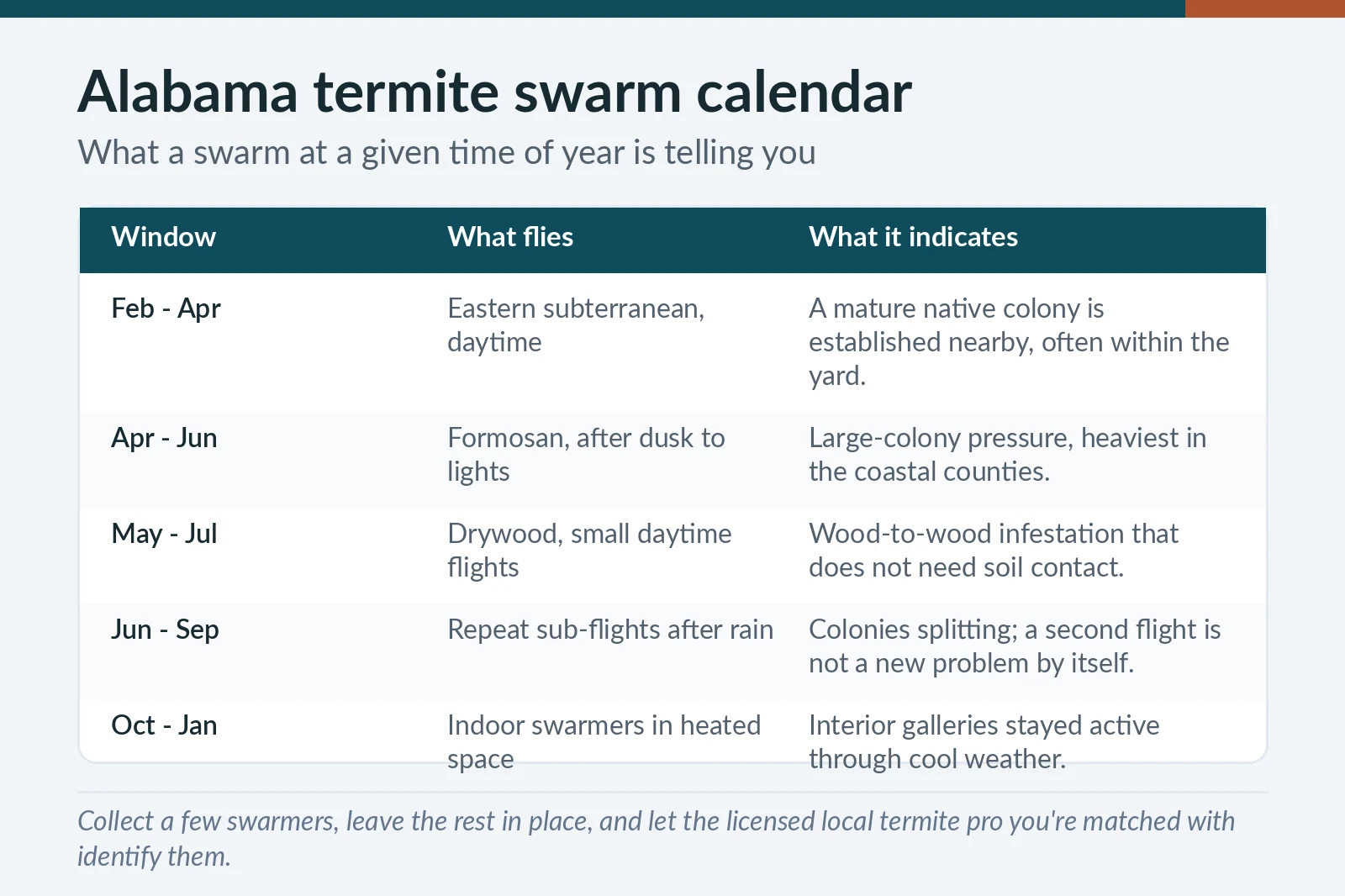
The Mobile swarm calendar
When each species flies on the central Gulf Coast — so you can describe it accurately on the call.
| Window | What’s flying in Mobile & Baldwin County |
|---|---|
| Feb–Apr | Native Eastern subterranean swarms — dark swarmers in daylight on warm, still afternoons after rain. Watch windowsills, tub surrounds, stumps, and landscape timbers. |
| May–Jun | Formosan swarm season — pale swarmers in big numbers at dusk, drawn to porch lights, streetlights, and lit windows. Mobile’s signature termite event; operators book solid fast. |
| Jul–Sep | Drywood termite flights at night in late summer — smaller swarms into attics and eaves. Carpenter ant winged flights peak too and are constantly mistaken for termites. |
| Oct–Jan | The quiet season. No swarms, but colonies keep feeding year-round in this climate — and it’s the unhurried window to book a WDO inspection before the spring rush. |
Free to check coverage. ADAI-licensed operators serving Mobile & Baldwin County, AL.
Five questions to ask the operator after a swarm
A swarm visit goes better — and the quote gets fairer — when you ask these.
- “Which species swarmed?” Native subterranean, Formosan, and drywood termites take three different treatment plans at three different price points. The wings and the timing tell a licensed operator which one they’re looking at — make them say it out loud.
- “Where’s the colony evidence?” A swarm plus mud tubes, damaged wood, or frass is a diagnosis. A quote with no findings behind it is a red flag. Ask to see what they found, or photos of it.
- “Why this treatment and not the other one?” Liquid soil treatments and bait systems both have their place on the Gulf Coast; drywood problems may need targeted wood treatment instead. A good operator explains the why, not just the price.
- “What are the re-treat terms?” Termite work in this climate usually comes with a renewable agreement — what happens if activity returns, what the annual renewal covers, and what voids it. Get it in writing.
- “What’s your ADAI license number?” Every legitimate Alabama termite operator carries one, and the Alabama Department of Agriculture & Industries’ Pesticide Management Section — (334) 240-7240, Montgomery — can confirm it. Pros expect the question.
Termite swarm season — what do homeowners ask?
I found piles of wings but no insects. Is that termites?
Very possibly. Termite swarmers shed their wings almost immediately after flight, so a scatter of equal-length wings on a windowsill with no bodies is a classic after-the-swarm scene. Winged ants keep their wings attached, and their front wings are longer than the back pair. Save a few wings in a bag and photograph the rest in place — a licensed operator can usually ID the species from that alone.
Does a swarm outside mean my house is infested?
Not automatically. An outdoor swarm means a mature colony lives close by — in a stump, a woodpile, or the soil near the foundation. Your house may be untouched. But in Mobile’s “very heavy” termite zone, a mature colony that close is exactly what a licensed operator should evaluate; the inspection tells you whether it’s a yard problem or a house problem.
How do I tell a termite swarmer from a flying ant?
Three checks: waist, wings, antennae. Termites have a thick, straight body with no pinched waist, four equal-length wings that shed easily, and straight beaded antennae. Ants have an hourglass waist, unequal wings that stay attached, and elbowed antennae. Carpenter ants fly all summer in Mobile and are the most common false alarm.
When do Formosan termites swarm in Mobile?
May and June, at dusk, on humid evenings with little wind — and they fly toward light. Porch fixtures, streetlights, and lit windows draw them in large numbers. Native Eastern subterranean termites swarm earlier, February through April, in daylight on warm afternoons after rain. Drywood termites fly at night in late summer.
Are you a pest control company?
No — Mobile Alabama Exterminators is a free dispatch and referral service. We connect Mobile and Baldwin County homeowners with independent, ADAI-licensed termite and pest operators who perform every inspection and treatment themselves. We never do the work, and we encourage you to verify any operator’s license with ADAI before hiring.
How fast can an operator get out during swarm season?
It depends on the week. Once the big Formosan flights start in May, termite operators across Mobile County book up quickly. The dispatch line answers 24/7, but appointment timing is set by the independent operator, varies with their schedule, and is not guaranteed. Calling early — at the first February swarm or before the season entirely — usually means faster scheduling.
Wings on the windowsill? Call the dispatch line while the evidence is fresh.
, free to get matched, no obligation to hire. The licensed operator inspects and gives the quote.
Free to check coverage. ADAI-licensed operators serving Mobile & Baldwin County, AL.
Prefer to send details first? Use the contact form →