Pest control in Elberta, AL — feed-shed rats, pasture fire ants and carpenter ants in the pines
Rats in the feed shed, fire ant mounds across the pasture, carpenter ants trailing out of the pines — Elberta’s farm country brings farm-country pests, and the new subdivisions off Highway 98 get their own list. This free 24/7 referral line connects you with an independent local pest control company serving south Baldwin County. It inspects, quotes and treats. You decide.
Rats in the feed shed or barn?
Call, enter your 5-digit ZIP on the keypad, and get connected live with a local pest control company. Free to call, 24/7.
Why pest control in Elberta is its own discipline
Elberta is Baldwin County’s German-heritage farm town — the place that throws a sausage festival twice a year and still runs on acreage, barns, and long gravel drives off Highway 98 and County Road 83. But it’s changing year by year: new subdivisions are filling in the fields between Elberta and Foley, and a slab starter home on a fresh-cleared lot has a completely different pest profile than a farmhouse with a feed shed.
Three local realities shape most of the calls that come off this page:
- Barns and feed sheds are rodent magnets. Anywhere feed, seed, or tack is stored, rats and mice follow — Norway rats burrowing under slabs and along foundation lines, house mice in the walls of the shed and then the house. Rural rodent work is about the whole property: bait placement, exclusion, and cutting off the food, not just a trap under the sink.
- Fire ants own the open turf. Pasture, hayfield edges, ball-field-flat lawns in the new subdivisions — south Baldwin’s sunny, sandy ground is prime fire ant country, and mounds multiply after every summer rain. Broadcast treatment on acreage is a different job than spot-treating a city yard, and it’s worth asking the operator which one they’re quoting.
- Wooded lots feed carpenter ants — and termites. Homes backed up to pine and oak stands see carpenter ants trailing from stumps and dead limbs into soffits, and subterranean termites working from old root systems toward the slab. New construction isn’t exempt: builders clear the trees, but the colonies stay in the ground.
One more rural reality: most Elberta acreage runs on wells and septic systems, which means moisture around the drain field, deep grass at the field lines, and outbuildings the county never sees. Snakes, raccoons, and opossums move through all of it — ask whether the company you’re connected with handles wildlife removal and exclusion along with the insect work.
None of that is a reason to panic. It’s a reason to get a local, professional set of eyes on the property instead of guessing from the co-op shelf.
Seeing activity right now? Once you’re connected, describe exactly what you’re seeing — “droppings on the feed sacks,” “mounds all along the fence line after the rain,” “big black ants coming out of the wall by the porch.” That detail helps the company show up with the right gear for acreage instead of scheduling a second trip.
What a thorough Elberta pest visit looks like
Acreage needs an acreage inspection — here’s what good looks like.
A five-acre place with a barn takes more walking than a quarter-acre lot in a new subdivision — and a good operator budgets time for it. On a general pest call in Elberta, a thorough visit usually covers:
- The outbuildings, not just the house. Feed rooms, tack sheds, pole barns, and well houses — checking for burrows along the slab edges, gnaw marks on sacks and wiring, and rub marks on the rafters. Rodent work that skips the barn fails by Christmas.
- The turf, walked — not eyeballed from the driveway. Mound density across the pasture or lawn tells the operator whether spot treatment or broadcast bait makes sense, and where the re-infestation pressure will come from.
- The tree line and stumps. Carpenter ant trails from dead pine, termite activity in old root systems near the slab, and limbs bridging onto rooflines.
- Foundation, slab seams, and plumbing penetrations — on both farmhouse piers and new-construction slabs, the entry map for ants, roaches, and mice.
- A written scope. What they found, what they propose, what it costs, and the re-service terms. Pricing is the operator’s, set after inspection — which is exactly why we don’t publish prices on this site.
If the visit never leaves the front yard and the quote arrives without findings, you’re allowed to say no. The quote belongs to the operator, and the decision belongs to you.
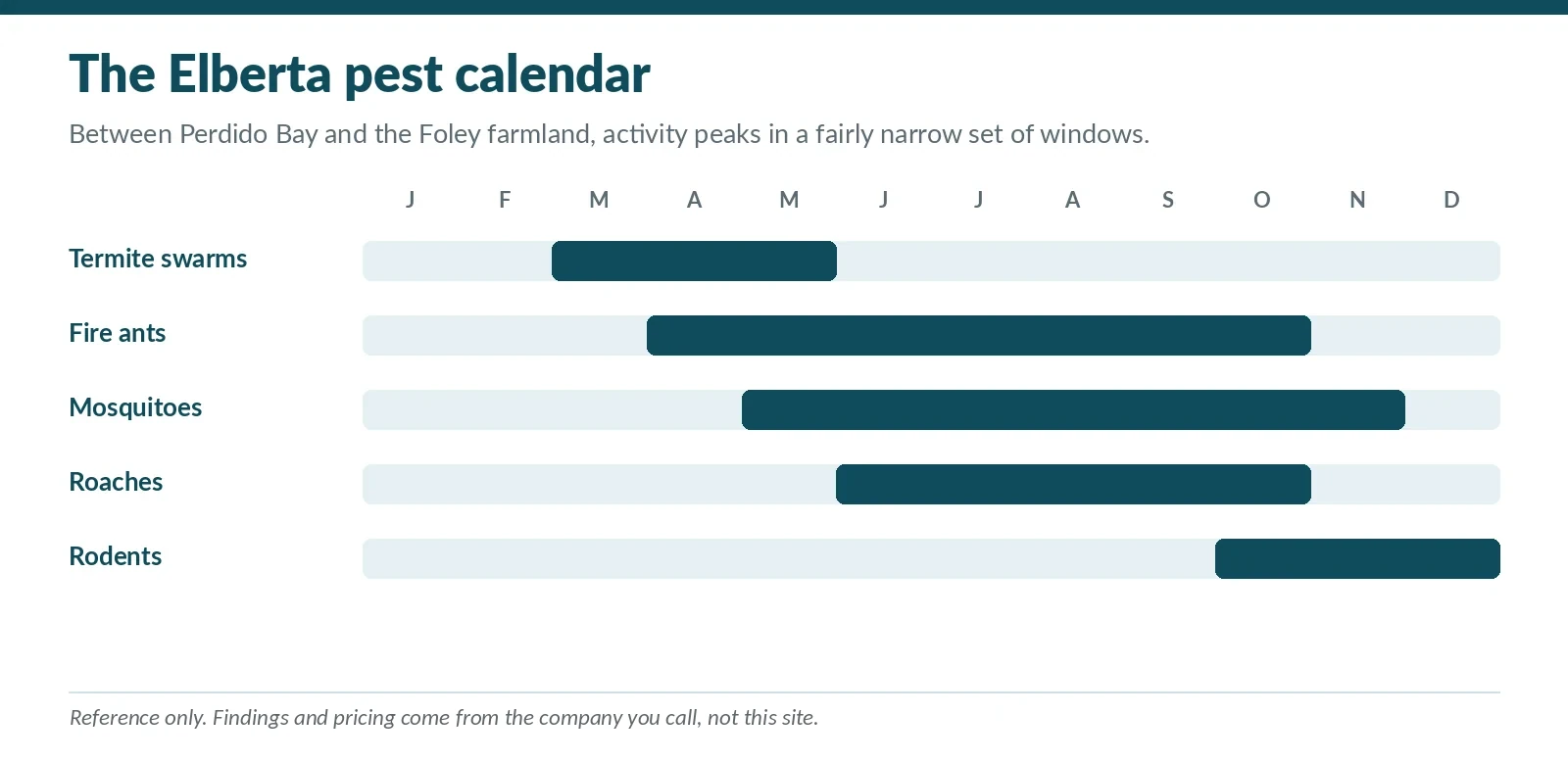
The Elberta pest calendar
What tends to show up when in south Baldwin farm country — so you can describe it accurately once you’re connected.
| Season | What shows up around Elberta places |
|---|---|
| Feb–Jun | Termite swarm season — native subterraneans first, then Formosans on humid May–June evenings. On cleared lots, swarms often come off old root systems the builder left behind; wings on sills deserve a professional look soon. |
| Apr–Oct | Fire ant mounds multiply across pasture and lawn after every rain; carpenter ants trail from the pine line into soffits; house crickets and earwigs ride irrigation moisture into garages. |
| Jul–Sep | Peak heat: smokybrown roaches fly on humid nights, silverfish settle into hay lofts and storage boxes, millipedes surface after field-flooding downpours, and snakes work the tall grass at the field edges (a wildlife call, same line). |
| Oct–Mar | Rodent season — harvest ends and rats and mice move from the fields into barns, feed rooms, and then houses as nights cool. Raccoons and opossums test outbuildings; spiders turn up in wood piles and storage. |
Pests at your Elberta home?
Call, enter your 5-digit ZIP on the keypad, and get connected live with a local pest control company. Free to call, 24/7.
What should you ask the operator?
You’ll get a better outcome — and a fairer quote — if you ask these on the first visit.
- “What species are we dealing with?” Species drives protocol. Norway rat vs. roof rat, carpenter ant vs. termite, fire ant vs. native ant — each pair takes a different plan and a different budget, and on acreage the wrong call wastes a season.
- “What’s your ADAI license number?” Every legitimate Alabama operator has one, and the Pesticide Management Section in Montgomery can confirm it. A pro expects this question.
- “Is this quote for the house or the whole property?” On a farm place, make the operator spell out whether the barn, sheds, and pasture are in scope — that’s where Elberta jobs succeed or fail.
- “Spot treatment or broadcast?” For fire ants on open turf, ask which approach they’re quoting and why. Both are legitimate; the acreage and mound density decide it.
- “What do I need to do before treatment?” Good operators give prep instructions — moving feed sacks, mowing before turf treatments, keeping animals off treated ground for the label interval. If prep never comes up, ask why.
Pest control in Elberta — what do homeowners ask?
Are you a pest control company?
No — Mobile Alabama Exterminators is a free referral line. We connect Elberta and Baldwin County homeowners with independent pest control operators who perform the inspections and treatments. We never do the work ourselves, and we encourage you to verify any operator’s license before hiring.
How much does pest control cost in Elberta?
It depends on the pest, the property, and the scope — and the price is set by the independent operator, not by us. Five acres with a barn is a different job than a new slab home off Highway 98, so a real number requires an inspection. The call is free; the operator gives you their quote before any work begins.
Can the operators handle rats in a barn or feed shed?
Usually — rural rodent work is common around Elberta, so ask the company you’re connected with whether barns and sheds are in its scope. Expect a whole-property approach: sealed feed storage, tamper-resistant bait stations along the runs, exclusion work on the shed and house, and a follow-up visit to confirm the pressure dropped.
Can fire ants on acreage actually be controlled?
Yes, with the right approach. Broadcast bait across open turf knocks down colonies at scale, while individual mound treatments handle the stragglers near the house and outbuildings. Expect a straight answer, too: pasture next to untreated land re-seeds over time — which is why re-service terms matter on acreage.
We just built on a cleared lot — why do we already have ants and termites?
Clearing removes the trees, not the colonies. Carpenter ants and subterranean termites keep working the stumps and root systems left in the ground, and a new slab with fresh landscaping sits right on top of that pressure. An inspection maps what’s active around the foundation before it becomes a structural problem.
Do the operators cover my part of Elberta?
Yes. Call (888) 295-0220 and enter your ZIP, and you’re connected live with an independent local pest control company that serves your address. The line is open 24/7.
Check the company before treatment starts
In Alabama, companies that do structural pest control, including household pest, termite and fumigation work, must hold a Professional Services license from the Alabama Department of Agriculture and Industries (ADAI). Ask for the company’s license and the name of its certified operator, and check with the ADAI Professional Services program before work starts.
Get the treatment plan, the products to be used, any follow-up visits and the price in writing. For termite work, ask what the contract covers, whether it’s retreatment only or includes repair of damage, and how long it lasts.
How the call works
- Call (888) 295-0220. Any time, day or night.
- Enter your 5-digit ZIP code on your phone’s keypad when prompted.
- Get connected live with a local pest control company that serves your ZIP. Describe what happened and ask when they can come out and what the job will cost.
Mobile Alabama Exterminators is a free referral line that connects callers with independent local pest control companies. We don’t perform the work. The company you’re connected with gives the quote, does the work and stands behind it.