Bed bugs after holiday travel: what every Alabama traveler and host should check.
Thanksgiving and Christmas send more Alabamians through more hotel rooms, guest rooms and rental cars than any other six weeks of the year — and bed bugs travel exactly as well as people do.
☎ Call (888) 295-0220
Free 24/7 dispatch · anywhere in Alabama
Holiday travel is the single biggest bed bug risk window of the year because more people move through more shared beds — hotels, relatives’ guest rooms, rental properties — over Thanksgiving and Christmas than any other stretch of the calendar. A five-minute check of the headboard and mattress seams at check-in, keeping luggage on the rack instead of the bed or floor, and running everything through a hot dryer the moment you get home cuts the risk dramatically. One bug caught early is an inspection, not an infestation.
Why does bed bug risk spike specifically around Thanksgiving and Christmas?
Bed bugs don’t travel on their own — they travel in luggage, coat pockets, backpacks and car trunks, riding along with whoever picked them up at the last stop. Holiday travel concentrates exactly the conditions that let that happen: more overnight stays packed into a shorter window, more suitcases opened on more hotel beds and more guest-room floors, and more relatives sleeping in spare rooms that only get used a few weeks a year. A hotel room that hosted a traveler with an unnoticed hitchhiker in early November can pass that hitchhiker to the next several guests before anyone connects the dots, and Alabama’s interstate corridors — I-65, I-59, I-85, I-10 — carry a heavy share of that Thanksgiving-week and Christmas-week traffic.
It isn’t just hotels. Extended family gatherings mean guest rooms, pull-out sofas and air mattresses that sit unused most of the year suddenly host a cousin’s family for four nights, and those same relatives may have just driven in from their own hotel stop along the way. The risk isn’t any one link in the chain — it’s that holiday travel multiplies the number of links. That’s exactly why the checks below take five minutes and are worth doing at every stop, not just the first one.
The good news: bed bugs are slow. They don’t jump or fly, and a single hitchhiker caught at the door or in a suitcase pocket is a completely different situation than an established population in a mattress seam. Catching it early is the whole game.
What does the 5-minute hotel-room check actually look like?
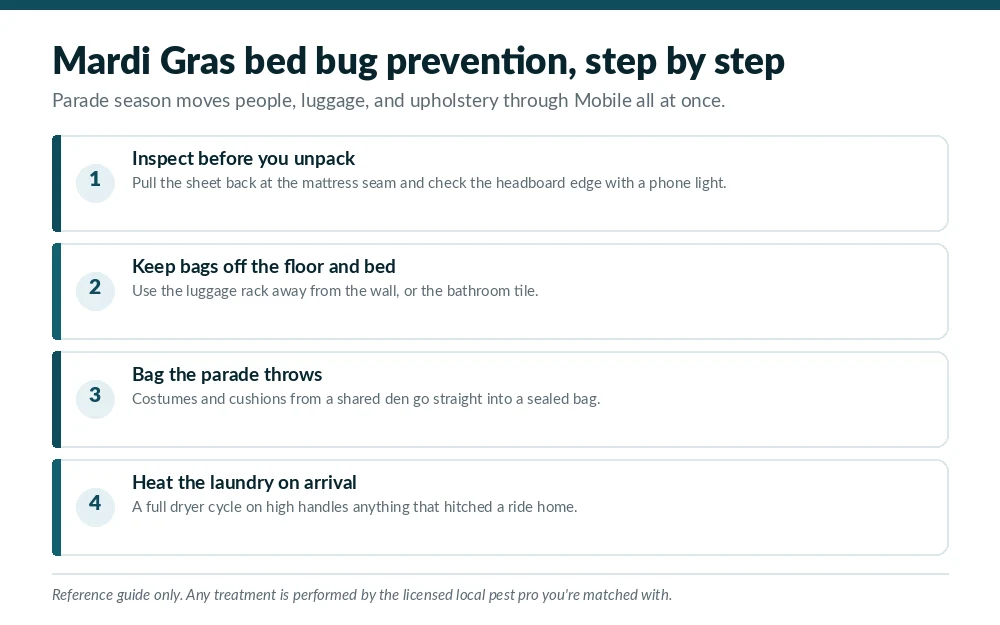
Do this before you unpack, ideally still holding your bag in the doorway. Pull back the sheets and check the mattress seams and piping, especially at the corners near the headboard — that’s the single most common hiding spot, since it’s close to a sleeping body but rarely disturbed by daily housekeeping. Look for small reddish-brown insects about the size of an apple seed, but also for the secondary signs that show up even when the bugs themselves are hiding: tiny dark spotting (fecal marks), pale yellowish shed skins, or small blood spots on the sheet.
Next, check the headboard itself — lift it away from the wall if it’s mounted, since the gap between headboard and wall is prime harborage. Then check the seams of any upholstered chair or the edge of the bed skirt if there is one. This whole check takes under five minutes and it’s the difference between finding a problem before your suitcase is open on the bed and finding it after you’ve already brought something home.
The single most useful habit, though, doesn’t require finding anything: keep luggage on the rack, never on the bed or the floor. Nearly every hotel room in Alabama has a folding luggage rack for exactly this reason, and it keeps your bag up off the two surfaces most likely to have activity if a room does have a problem. If a room fails the check — any sign at all — ask for a different room that isn’t adjacent (bed bugs move room to room along shared walls and plumbing chases), not just the room next door.
Found something after a holiday trip or a houseful of guests? Tell the dispatcher what you found and where, plus your city. You’ll be matched with an independent, ADAI-licensed operator who covers your Alabama address and can inspect and confirm before anyone treats anything.
What’s the coming-home protocol, and does it change if you were hosting instead of traveling?
Whether you spent the holiday in a hotel or hosted family in your own guest room, the same principle applies: treat the return trip — or the day guests leave — as the moment to break the chain, not an afterthought. For travelers coming home: run every washable item that was in the suitcase through a hot dryer first, even things that don’t look like they need washing — the dryer’s heat is what matters, not the wash cycle, and bed bugs and their eggs don’t survive a full hot-dryer cycle. Do this before anything from the trip touches a closet, hamper or bed. The suitcase itself should go straight to the garage or get wiped down and inspected in a bathtub, not set down in a bedroom.
For hosts, the work happens on both ends. Before guests arrive, a quick check of the guest-room mattress seams and headboard establishes a clean baseline — the same five-minute check as a hotel room, just in your own house. After guests leave, that same check again, done without any awkwardness or accusation, simply confirms nothing came in during the stay. If anything turns up, the earlier it’s caught after guests leave, the smaller the problem, and it’s a completely normal, low-drama thing to check — most guests would rather a host check quietly than deal with a spreading problem discovered later.
One more holiday-specific wrinkle: college kids home for break. A student returning from a dorm or off-campus apartment for Thanksgiving or Christmas is, functionally, another traveler bringing a duffel bag home, and the same suitcase protocol applies to their laundry too. That’s a related but different problem from what happens on campus during the school year — the college apartments bed bug guide covers the lease-turnover and shared-hallway dynamics specific to student housing, while this page is about the travel and hosting side of the holidays. If a student’s bag checks out clean at the door, that’s one less thing to think about at the dinner table.
What does finding one bug actually mean — and where can Alabamians get help?
Finding a single bed bug in a suitcase pocket or on a mattress seam is not the same thing as having an infestation, and it’s worth saying plainly: one hitchhiker caught early usually means a targeted inspection, not a house-wide event. Bed bugs reproduce slowly relative to something like a roach, and a single insect found and dealt with quickly — isolated, laundered hot, area inspected — rarely turns into a spreading population. Panic is the wrong response; a calm, thorough look at the areas where it was found is the right one.
What does call for a licensed inspection is multiple bugs, bugs found in more than one room, or the secondary signs (spotting, shed skins, bites in a line or cluster) showing up without an obvious single source. That distinction — one bug versus a pattern — is exactly the kind of call worth getting a professional opinion on rather than guessing, since heat and chemical treatment options differ by situation and a licensed operator can confirm what’s actually there before recommending either.
Alabama’s bed bug pressure isn’t limited to one region — it follows travel and housing turnover everywhere in the state. The Mobile, Birmingham, Huntsville, Montgomery and Hoover bed bug pages, along with the Madison and Decatur pages, all cover what a licensed inspection and treatment plan look like locally — useful reading whether the holiday stop was a hotel on I-65 or a relative’s guest room off I-59.
Questions people ask
No — it’s a free 24/7 dispatch and referral line. Call (888) 295-0220, describe what you found and your location anywhere in Alabama, and you’re matched with an independent operator licensed by the Alabama Department of Agriculture & Industries. That operator — not the dispatch line — inspects, confirms and sets the treatment plan and price.
Yes. A clean-looking, newly renovated room can still have activity in the mattress seams or behind the headboard — appearance and cleanliness don’t correlate with bed bug presence, since they hide in cracks and seams rather than open surfaces. The five-minute seam-and-headboard check takes the same amount of time regardless of how the room looks.
Shopping bags and gifts carried from stores are a much lower risk than luggage that’s been in a hotel room or another home overnight, since bed bugs need an overnight stay near a sleeping area to hitchhike. The higher-risk items are suitcases, overnight bags and anything that sat on or near a bed.
Isolate the area — strip the bedding, run it through a hot dryer, and avoid moving items out of that room into others until it’s been checked. A licensed inspection can confirm what’s actually present and whether it’s contained to that one room, which is common when it’s caught soon after guests leave.
A full cycle on high heat is genuinely effective against bed bugs and their eggs in washable fabrics — it’s one of the few DIY steps that actually works well, which is why it’s the first move for luggage contents. It doesn’t address anything already in a mattress seam or wall void, though; that’s inspection-and-treatment territory.
Found something after a holiday trip? Make one free call.
Describe what you found and your city, get matched with an independent ADAI-licensed bed bug operator who works your area. Free call, 24/7, anywhere in Alabama.