Termite treatment in Dothan, AL — one call to a licensed operator.
From the peanut-country farmsteads ringing Ross Clark Circle to the century-old frame houses near Foster Street downtown, our 24/7 dispatch line matches Dothan homeowners who suspect termites with an independent, ADAI-licensed exterminator who already works the Wiregrass every week. You call, we match, the licensed operator inspects, identifies the species, and quotes the fix.
One call, and you’re matched
Tell the dispatcher what you’re seeing — mud tubes climbing a pier under a ranch-slab house inside Ross Clark Circle, a drift of shed wings on a downtown windowsill after a warm February rain, blistered paint on a baseboard near an irrigated field edge — and get matched with a licensed operator who covers your part of Houston County.
☎ Call (888) 295-0220 (888) 295-0220 — answered 24/7Free call · No obligation to hire anyone · The licensed local exterminator you’re matched with inspects and sets the price
Mobile Alabama Exterminators is a free 24/7 dispatch and referral line. Call (888) 295-0220, describe what you’re seeing — mud tubes, wings, damaged wood — and we match you with an independent exterminator licensed by the Alabama Department of Agriculture & Industries who covers your Dothan address. The licensed operator, not us, inspects, identifies the termite species, and sets the price for treatment.
Why does Wiregrass sand make Dothan its own kind of termite problem?
Dothan sits deep in the Wiregrass, the sandy coastal-plain country of Alabama’s southeast corner where peanut farming built the local economy and shaped the ground under every house in the county. That sand is the whole story for termites here. Unlike the packed red clay of Alabama’s Piedmont cities, the sandy loam under Houston County lets a subterranean termite colony dig fast and forage wide, moving through loose sand far more easily than through dense clay. That same sand changes how a liquid termiticide behaves once it goes into the ground — it percolates and drains faster than clay, so trench depth and application rate matter more here. That is a fair question to put to any operator working a Wiregrass property.
The eastern subterranean termite is the species doing the work here — Dothan sits well inland of the Formosan pressure that concentrates along the immediate Gulf coast in Mobile and Baldwin counties, so a Houston County inspection almost never needs to consider that species. What it does need to consider is timing. Wiregrass swarm season starts earlier than it does farther north, often beginning in February and running into April, timed to the first warm, humid days after winter. A cluster of shed, translucent wings on a windowsill in late winter is not unusual in Dothan the way it would be elsewhere in Alabama — it is simply the local calendar.
Housing stock inside Ross Clark Circle — the beltway ringing the city’s commercial core — runs heavily to postwar ranch homes on concrete slabs, many built before pretreatment during construction was standard practice, others where an original pretreatment has long since aged out. A slab hides termite entry points inside expansion joints and the seam where slab meets brick veneer, so an operator typically drills through it at intervals to treat the soil underneath rather than trenching an exposed perimeter.
Downtown and the historic streets near Foster Street — where the city’s outdoor mural collection has turned old brick storefronts into something of a local landmark — carry a different housing stock: early-1900s frame construction on pier foundations, with decades of paint that can mask early damage until a baseboard finally blisters. Pier construction gives clearer sightlines than a slab, but also more wood-to-soil contact points to check.
Peanut country brings one more variable other Alabama cities rarely deal with: irrigation. Center-pivot and drip systems keep field-edge soil damp through the growing season, and that pattern extends into subdivisions built along old farmland, keeping foundation soil damp longer into summer than it otherwise would. Damp soil next to a foundation is exactly what a subterranean colony favors, which is why drainage and irrigation placement are worth mentioning to the dispatcher.
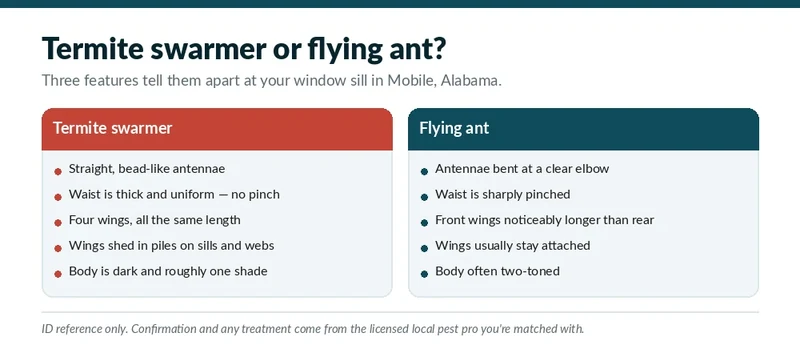
- Swarmer or flying ant? Termite swarmers have two pairs of wings of equal length, straight beaded antennae and a thick waist; flying ants have unequal wing pairs, elbowed antennae and a pinched waist. Getting this right before you call saves a misdirected inspection.
- Bait or liquid, in this soil? Fast-draining sand affects both approaches differently than clay does — ask the operator which protocol fits your specific foundation and yard.
- Retreat bond or repair bond? One covers the operator returning to retreat; the other also covers new damage. Ask which applies and what triggers it.
Slab seams inside Ross Clark Circle, pier foundations downtown, and irrigation-fed moisture at the edge of peanut country each point a Dothan inspection in a different direction. An operator who already works the Wiregrass every week knows to check all three before recommending a protocol.
Seeing wings or mud tubes in Dothan right now? Tell the dispatcher exactly where — a slab seam inside Ross Clark Circle, a pier foundation downtown, a foundation edge near an irrigated yard — so you’re matched with an operator who already knows that soil and foundation type.
☎ Call (888) 295-0220Free call · 24/7 · No obligation to hire — the licensed operator you’re matched with gives the quote
How does the termite dispatch line work in Dothan?
Total transparency: we answer phones and match. Licensed operators do the work.
You call, we listen
Tap the number, day or night, and tell the dispatcher what you’re seeing in Dothan — it takes about a minute, costs nothing, and you’re not committing to anything.
We match you locally
Mobile Alabama Exterminators is a dispatch and referral service, not a pest control company. We route your call to an independent operator licensed by the Alabama Department of Agriculture & Industries who covers Dothan and the surrounding Houston County area.
The operator takes over
The licensed operator inspects your property, walks you through what they found, and gives you their own quote. Hiring them is entirely your decision — and you can verify their ADAI license first through the Pesticide Management Section in Montgomery at (334) 240-7240.
What else can you call the Dothan line about?
The dispatch line routes five core problem types across Dothan and Houston County. Each links to a deeper guide on this site.
Pest control in Dothan →
The parent hub for every pest problem across the city, from downtown storefronts to the Ross Clark Circle commercial ring.
Termite control →
The full statewide termite guide — species, protocols, and what a licensed inspection actually covers.
Roach exterminator in Dothan →
American, smokybrown and German roach pressure across Dothan’s canopy streets and commercial corridors, covered in the companion guide.
Termite swarming season →
When and why Alabama termites swarm, and how Dothan’s early Wiregrass calendar differs from the rest of the state.
Bait vs. liquid termiticide →
A closer look at how bait stations and liquid termiticide compare, relevant to Dothan’s fast-draining sandy soil.
When is termite pressure worst in Dothan?
Wiregrass sand and an early swarm calendar set the rhythm differently than it runs farther north in Alabama.
| Season | What shows up in Dothan homes |
|---|---|
| Feb-Apr | Swarm season starts early here — winged termites and shed wings appear on downtown windowsills and Ross Clark Circle slab homes after the first warm, humid stretch following winter. |
| May-Aug | Colonies forage hardest through peanut country’s irrigated growing season; damp field-edge soil keeps foraging active near subdivisions built along old farmland. |
| Sep-Nov | Foraging slows above ground but sandy soil dries fast, so colonies push deeper for moisture — irrigation and drainage near the foundation matter more than the calendar. |
| Dec-Jan | Colonies retreat into warmer, damp soil pockets; a heated slab or a pier foundation near a leaking downspout can still show quiet winter activity. |
Not sure if it’s active? Tell the dispatcher when you saw it and what kind of foundation your house sits on — slab or pier — that alone narrows which operator and protocol fit Wiregrass sand.
☎ Call (888) 295-0220Free call · 24/7 · No obligation to hire — the licensed operator you’re matched with gives the quote
What should you ask the operator about Wiregrass soil and your foundation?
Asking these on the first visit gets you a better outcome — and a fairer quote.
- “Is this eastern subterranean, or could it be something else?” Formosan termites are a coastal Mobile and Baldwin County problem, not a Dothan one. A licensed operator should identify the species from wings or workers on site before recommending a protocol.
- “What’s your ADAI license number?” Every legitimate Alabama operator carries one, and the Pesticide Management Section in Montgomery can confirm it. A pro expects the question and answers without hesitation.
- “How does Dothan’s sandy soil change your trench depth or bait placement?” Fast-draining sand percolates a liquid termiticide differently than clay does, and it changes how bait stations get sited. Ask the operator to explain how they adjust for it.
- “Does my foundation call for slab drilling or pier trenching?” Ross Clark Circle’s ranch-slab stock and the pier-foundation houses near downtown need different approaches. Ask the operator to explain why they are recommending one over the other.
- “Is this a retreat bond or a repair bond?” A retreat bond covers the operator coming back and re-treating; a repair bond also covers damage discovered later. Ask which one applies and how the annual reinspection is scheduled.
None of these questions slow down an operator who actually works Houston County’s sandy soil and mixed foundation stock every week — the answers tell you who you’re dealing with before any work starts.
Termite treatment in Dothan — what do homeowners ask?
Are you a pest control company in Dothan?
No — Mobile Alabama Exterminators is a free dispatch and referral service. We connect Dothan homeowners with independent, ADAI-licensed pest control operators who perform the termite inspection and treatment. We never do the work ourselves, and we encourage you to verify any operator’s license before hiring.
How much does termite treatment cost in Dothan?
The price is set by the independent operator after they have inspected and identified the extent of the problem — it depends on the foundation type, the treatment method and the size of the structure. The call and the match are free; ask the operator what drives their quote.
Why does Dothan’s swarm season start earlier than the rest of Alabama?
Wiregrass sand warms and drains faster than clay soil farther north, and mature colonies respond to that first stretch of warm, humid weather. February and March swarms are common here while much of the state is still waiting on April.
Does the sandy soil around Dothan really change how termites are treated?
Yes. Fast-draining sand affects how a liquid termiticide percolates and how bait stations perform, so trench depth and station placement are worth asking about directly. An operator who works Houston County soil regularly should have a ready answer.
Which parts of Dothan does the line cover?
The line routes across the city — the Ross Clark Circle commercial ring, the historic blocks near Foster Street downtown, the peanut-country subdivisions toward the county line — plus the rest of Houston County. Call and the dispatcher confirms coverage for your address.
Can I get someone after hours in Dothan?
The dispatch line answers 24/7. Appointment timing is set by the independent operator and depends on their schedule and your location — availability varies by operator and time of day. The operator confirms timing with you directly.
Ready when you are — day or night.
, free to get matched, no obligation to hire. The independent ADAI-licensed operator who covers your Dothan soil and foundation type inspects and gives the quote.
☎ Call (888) 295-0220(888) 295-0220 — free call, 24/7. The licensed operator inspects and gives the quote.