Bee removal in Mobile, AL calls for a different approach than wasps: honey bees are valuable pollinators, and the goal is live removal and relocation whenever it is feasible. Correct handling depends on the situation — a swarm clustered on a branch, an established colony in a wall, or an aggressive Africanized colony — and typically includes removing the comb so the cavity does not re-attract bees.
Dealing with a pest problem right now?
📞 Call now — get matched with a licensed local exterminator: (888) 295-0220When you call, stay on the line for a few seconds while we match you with the licensed local exterminator for your area. Have your address and a quick description of the problem ready.
Licensed local pros · Fast response, subject to availability · No obligation
Who handles bee calls in Alabama
Call our dispatch line about a bee problem and we’ll take the call and help point you the right direction. A clustered swarm is usually simplest to hand off to a local beekeeper — many collect swarms at little or no charge, and the Alabama Cooperative Extension System runs a statewide Swarm Patrol beekeeper directory that matches you with one nearby. An in-wall colony needs a beekeeper or bee-removal specialist who does cut-outs; the ADAI Apiary Protection Unit oversees beekeeping in the state. Either way, call and we’ll advise and route you toward the right help.
Seeing fast, aggressive insects around a wall gap or the ground? Those are usually yellow jackets, not honey bees. And if your actual problem is ants, roaches, termites, or rodents, that is a call we dispatch — start with pest control in Mobile, AL.
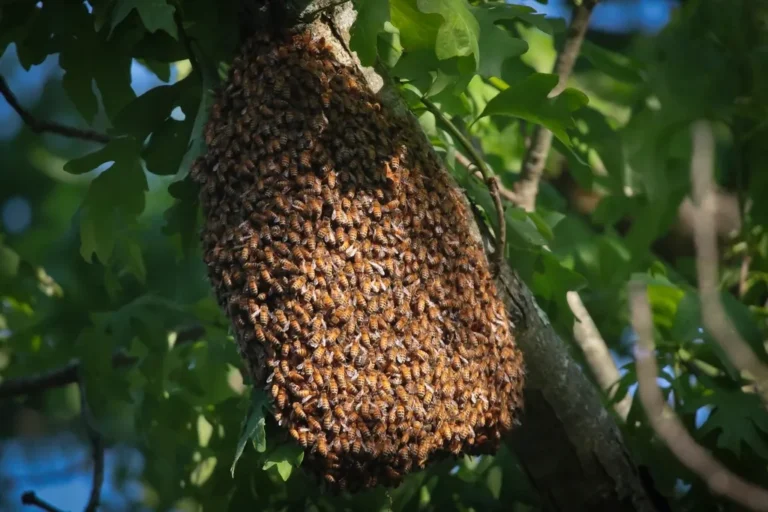
Swarm vs. established colony
A swarm is a temporary cluster of bees, often on a branch, fence, or eave, that has left a hive to find a new home — it usually has no comb yet and can frequently be collected and relocated within a day or two. An established colony has moved into a void (a wall, soffit, chimney, or tree) and built comb full of brood and honey. That requires a cut-out: opening the cavity, removing the bees and all the comb, and sealing the entry. Leaving comb behind is the classic mistake — the wax and honey rot, attract pests, and draw new bees to the same spot. For broader context, see general pest control in Mobile.
Why you should not seal or spray bees in a wall
Sealing the entrance traps thousands of bees that then push inward, often emerging inside the home. Spraying a large in-wall colony can leave decomposing bees and abandoned honey that leaks through drywall and attracts ants, roaches, and rodents. Proper removal addresses the whole colony and the comb at once.
A note on Africanized honey bees
Africanized (“killer”) bees are present in parts of the Gulf Coast and are far more defensive than European honey bees. A colony that reacts aggressively to normal yard activity should be treated as a safety hazard and handled by a professional rather than approached for relocation.
Frequently asked questions
Do honey bees get relocated instead of killed?
Live removal and relocation are preferred for honey bees whenever it is feasible — especially swarms. Established in-wall colonies and aggressive Africanized colonies are assessed case by case for safety.
How much does bee removal typically cost?
A simple swarm is the least expensive. A wall cut-out that requires opening the structure, removing comb, and sealing is more involved and priced according to access and repair.
There are bees in my wall — can the hole just be plugged?
No. Sealing traps the colony, which then pushes inward and can emerge inside the home. The bees and comb need to be removed first.
Is the comb removed too?
Yes. Leftover comb and honey rot, attract other pests, and draw new bees, so full comb removal is part of a proper job.
Related Mobile Alabama Exterminators pages
Mobile Alabama Exterminators is a free dispatch service that connects Mobile and Baldwin County homeowners with independent, ADAI-licensed pest control operators. We are not the treatment provider and do not perform inspections or treatments ourselves, and we do not guarantee specific results, pricing, or appointment availability. Requests are routed to participating local operators during their normal business hours; 24/7 availability is not guaranteed.