Sentricon is the bait-station termite control system most commonly recommended on the Gulf Coast as an alternative to liquid soil termiticide treatments. It is also one of the more confusing products on a homeowner’s plate at the point of decision, because the cost structure, the protection mechanism, and the renewal terms work differently from a traditional barrier treatment. Understanding what Sentricon actually does, what drives its cost over a five- and ten-year horizon in Mobile, and which homes benefit most from it makes the choice between bait and barrier simpler.
Dealing with a pest problem right now?
📞 Call now — get matched with a licensed local exterminator: (888) 295-0220When you call, stay on the line for a few seconds while we match you with the licensed local exterminator for your area. Have your address and a quick description of the problem ready.
Licensed local pros · Fast response, subject to availability · No obligation
How the system works
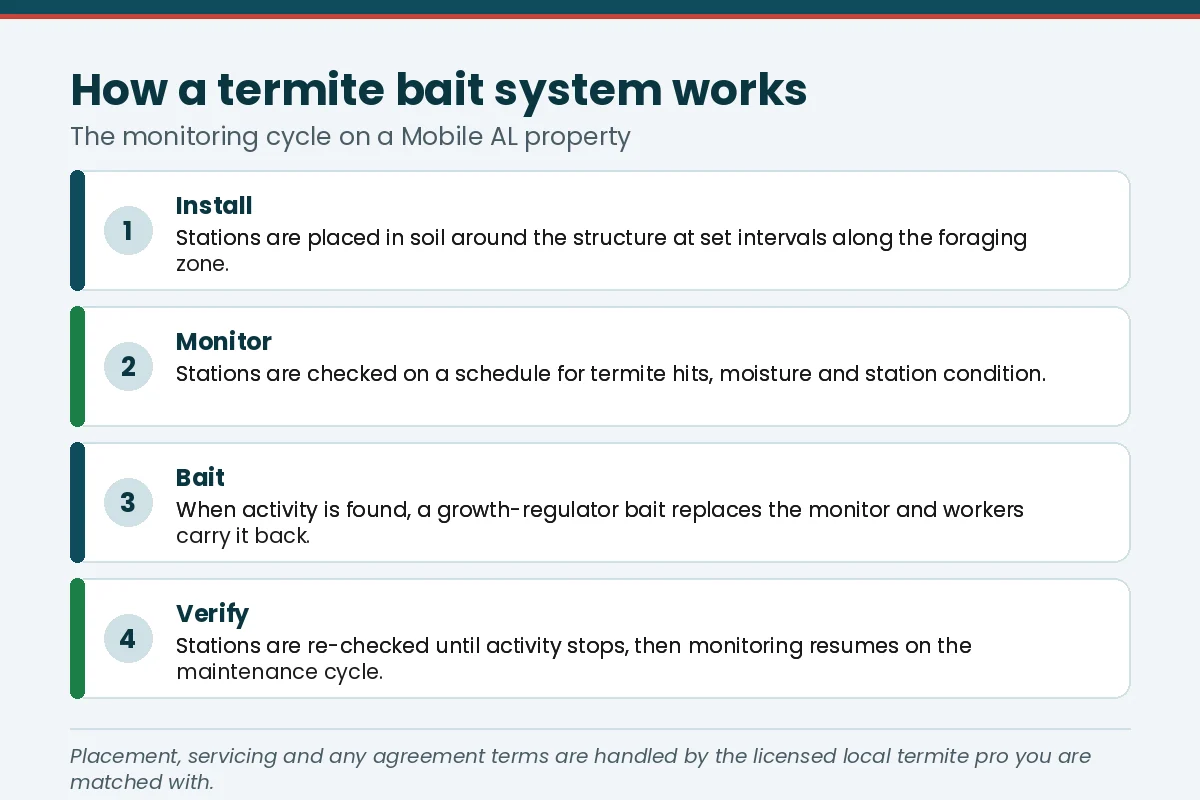
Sentricon stations are plastic in-ground devices installed in the soil around the perimeter of the structure, roughly ten feet apart and within a few feet of the foundation. Each station contains a bait matrix infused with noviflumuron, an insect growth regulator that disrupts the molting process. Foraging worker termites locate the bait, consume it, and carry it back to the colony where they share it with nestmates through the trophallaxis behavior that normally distributes food in a termite colony. Because noviflumuron is slow-acting and the bait is shared colony-wide, the entire colony eventually receives a dose. The colony collapses over weeks to months as workers fail to molt. The protection model is colony elimination rather than a soil chemical barrier.
Why Mobile and Baldwin homes are good candidates
Three local factors favor Sentricon in coastal Alabama. First, the soil. Sandy, fast-draining Gulf-Coast soils sometimes complicate the long-term integrity of liquid soil-termiticide barriers — the chemical breaks down faster or migrates more in sand than in clay. Stations are not subject to that constraint. Second, Formosan termites. Formosan colonies are massive, build aerial carton nests, and are more difficult for soil barriers to address comprehensively. A bait that targets the colony itself addresses Formosan biology directly. Third, slab homes with finished landscaping, fences, and patios. Trenching and drilling for a liquid treatment in a finished yard is invasive; station installation is not.
What drives the cost — initial and ongoing?
Sentricon costs come in two parts: the initial installation and the annual monitoring/renewal fee. Initial installation cost on a typical Mobile-area home depends mainly on the linear feet of perimeter, the operator, and any add-on services — a longer perimeter and more stations mean a higher installation cost. Annual renewal is priced separately and covers station monitoring, bait replacement when stations show activity, and the active termite bond. Over a five-year horizon, Sentricon’s cost structure runs higher up front with smaller annual renewals. A traditional liquid soil termiticide treatment is typically priced lower up front, with its own annual bond renewal — the two approaches often land in a comparable range over five years for a given home, and the operator you’re matched with can walk through the specific cost trade-off for your property at the inspection.
What the bond covers
The Sentricon bond from most operators in Mobile-Baldwin is a re-treatment guarantee: if termite activity is detected at any station between monitoring visits, the operator returns and reloads the bait. Many operators also offer a damage-repair warranty for an additional fee, which covers repair costs (capped) for any new termite damage discovered during the bond period. Damage warranties are not automatic — they are a separate line item — and the cap, the exclusions, and the inspection frequency all matter. A bond that covers re-treatment but not repair will still leave a homeowner with out-of-pocket repair cost for any active damage found before colony elimination.
When liquid termiticide is still the better choice
Three scenarios favor liquid soil treatment over Sentricon. An active heavy infestation already in the structure — bait works over weeks and months, and an active infestation often needs faster knockdown. Crawl-space homes with significant moisture and conducive conditions — liquid treatment along the perimeter and under piers provides a fast-acting chemical barrier that bait does not. Tight budgets where the up-front and annual costs of Sentricon are not feasible — liquid plus an annual bond is typically the lower-cost path up front. A licensed operator will discuss both options at the inspection.
What ongoing monitoring looks like
After installation, an ADAI Wood-Destroying Organi (WDC) licensed technician inspects each station once or twice a year. Stations that show activity are reloaded with fresh bait. Stations that look intact get visual inspection and stay in place. Most homeowners never see active stations because most stations on a properly installed property never get hit — termites are not foraging everywhere on the property, just along specific paths.
Frequently Asked Questions
How long does it take Sentricon to eliminate a colony? Once workers begin feeding on the bait, colony elimination typically takes 60 to 180 days depending on colony size and the rate of bait consumption. Formosan colonies can take longer because of their size.
Are pets at risk from the bait stations? No. Stations are locked, child-resistant, and in-ground. The active ingredient is contained inside the station and is not accessible to pets walking the yard.
Will Sentricon protect against drywood termites? No. Sentricon is designed for subterranean species — eastern subterranean and Formosan. Drywood termites do not forage through soil and require a different treatment approach.
Can I install Sentricon stations myself? No. Sentricon is sold and serviced only through Certified Sentricon Specialists — ADAI WDC-licensed operators who have been trained and authorized by the manufacturer.
If I sell my home, does the system transfer? Yes, in most cases. The bond transfers to the new owner with the operator’s consent, which is routine when annual fees are current.
Get Matched With a Licensed Exterminator
One call reaches a licensed, local exterminator who covers your address — and a real person answers, 24/7.
Mobile Alabama Exterminators is a 24/7 dispatch and matching service. We connect Mobile and Baldwin County callers with licensed, insured Alabama pest control exterminators. We are not a licensed pest control company and do not inspect, treat, or warranty pest control work.