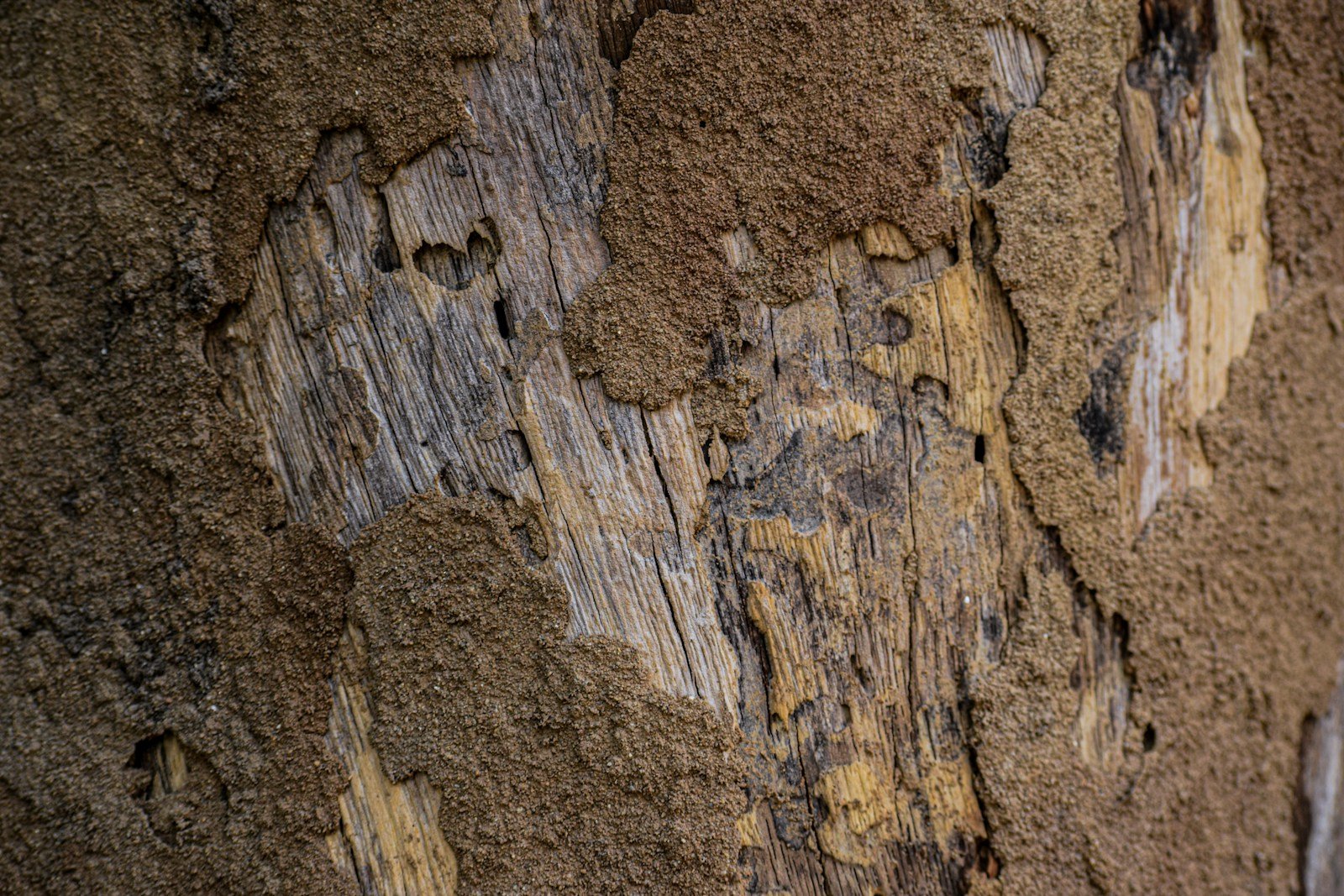
Most Mobile-area home buyers encounter the wood-destroying organism inspection — usually called the WDO inspection or the “termite letter” — for the first time when they are already under contract and the title company asks for it. The inspection sounds routine but it is the document that determines whether a closing happens on schedule, whether a buyer accepts the property as-is, or whether the seller is on the hook for a treatment they did not anticipate. Understanding what is actually being inspected, what counts as a finding, and what the finding obligates each party to do, prevents most of the surprises that derail Gulf-Coast closings.
Dealing with a pest problem right now?
📞 Call now — get matched with a licensed local exterminator: (888) 295-0220When you call, stay on the line for a few seconds while we match you with the licensed local exterminator for your area. Have your address and a quick description of the problem ready.
Licensed local pros · Fast response, subject to availability · No obligation
Quick answer: A WDO (wood-destroying organism) inspection is the termite-and-wood-pest report most Mobile and Baldwin closings require. An ADAI-licensed inspector checks the structure for termites, old damage, wood-decay fungi, and powderpost beetles, then issues the official Alabama Wood Infestation Inspection Report lenders rely on. Findings don’t kill a deal — they set up who treats and who repairs before closing.
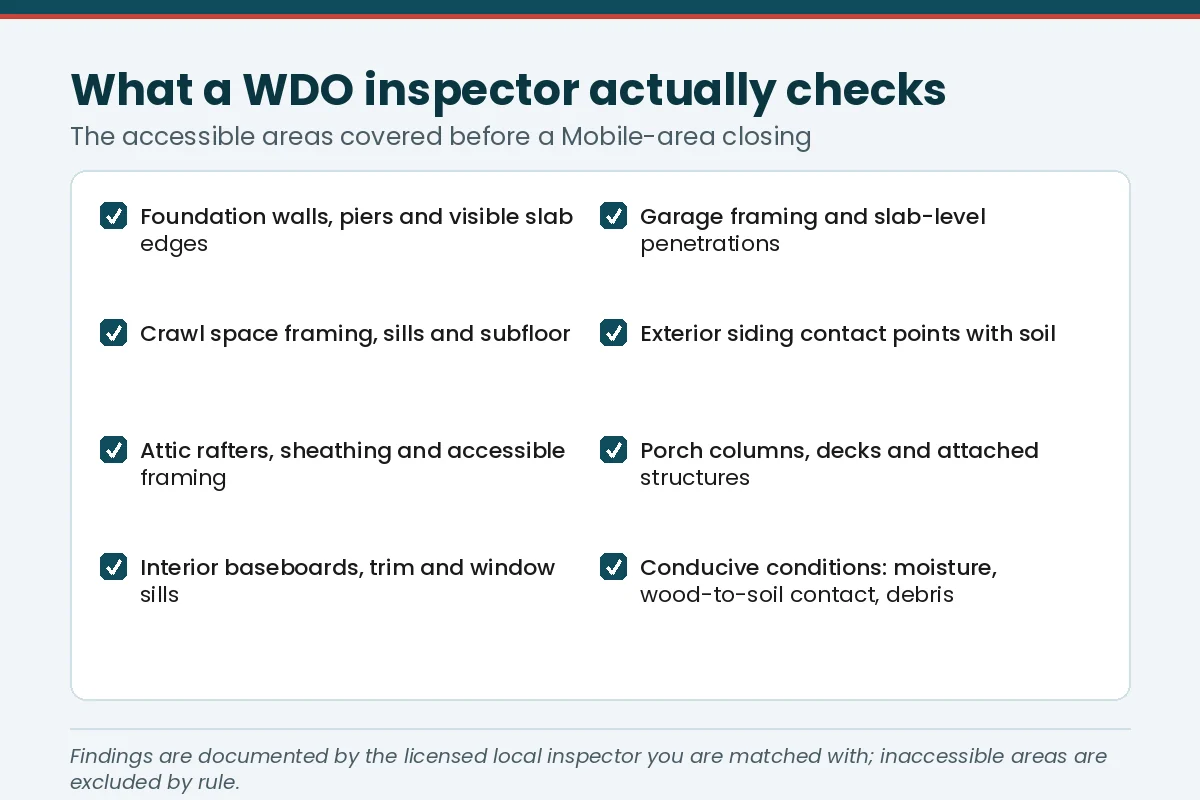
What does a WDO inspection actually cover?
The WDO inspection in Alabama is a visual examination of accessible structural wood for evidence of wood-destroying insects and wood-destroying fungi. The inspector is looking for subterranean termites, drywood termites, carpenter ants, carpenter bees, powderpost beetles, and the brown-rot and white-rot fungi that often accompany moisture conditions favorable to termites. The inspection is documented on the Alabama Official Wood Infestation Report — a specific multi-page form prescribed by the Alabama Department of Agriculture and Industries. The inspector must hold an ADAI Wood-Destroying Organi (WDC) license category. A general pest control license does not authorize WDO inspection work.
The four sections of the report and what each one means
Section I lists active infestation found at the time of inspection. Active means live insects, fresh mud tubes, recent damage with frass, or actively rotting fungus-infested wood. Section II lists evidence of previous infestation — old damage, dead galleries, old mud tubes — without active organi. Section III lists previous treatment history if known. Section IV lists conditions conducive to infestation: moisture, wood-to-soil contact, debris under the home, leaking gutters, plumbing leaks. A clean Section I and Section II is what most lenders and title companies are looking for. A Section IV finding alone is rarely a deal-breaker but typically gets addressed before closing.
Why Mobile and Baldwin reports often have findings
The Gulf Coast has some of the highest termite pressure in the United States. Eastern subterranean termites are native and ubiquitous. Formosan subterranean termites are established in Mobile County and spreading. The combination of high humidity, sandy soils, frequent rainfall, and the housing stock — many homes built between the 1950s and 1980s with crawlspaces, wood siding, and original landscaping that pushed mulch to the foundation — produces conditions where conducive-condition findings are routine and previous-evidence findings are common. A Section IV finding on a Gulf-Coast home is not a red flag; it is a fact of the local environment. The question is how recent and how active.
What a finding obligates each party to do
Alabama law and standard FHA/VA loan guidelines diverge somewhat on this. For most conventional loans, an active Section I finding means the seller arranges treatment by an ADAI-licensed operator before closing and provides a treatment certificate and a one-year termite bond. The buyer accepts the bond at closing. For an FHA or VA loan, the requirements are stricter: any Section I evidence usually requires treatment plus documentation, and certain Section IV findings (moisture conditions, wood-to-soil contact) also require correction. A Section II “previous evidence only” finding usually does not require treatment but does require disclosure. The closing attorney or the buyer’s agent walks the buyer through the loan-specific requirements.
The termite bond — what comes with the house
A termite bond is a service contract that obligates the issuing pest control operator to retreat if termites return within the bond period, and in many cases to repair damage from new infestation within the warranty terms. Bonds in Alabama are usually one-year initial periods with annual renewal, and they transfer to the new buyer at closing in most cases. A homeowner buying a Mobile-area home should ask three questions: which operator holds the bond, does it transfer at closing, and what does the renewal cost? A bond that does not transfer or that has lapsed is functionally not a bond — it is a piece of paper.
Cost factors and timeline
A standard WDO inspection on a Mobile-Baldwin single-family home typically takes 45 to 90 minutes onsite, and the report is usually delivered within 24 to 48 hours. Inspection cost depends on the size of the home and how accessible the crawlspace and attic are — the ADAI-licensed inspector sets the actual price. If active termites are found and pre-closing treatment is required, treatment cost depends on the size of the structure, the extent of the infestation, and whether Formosan termites are involved (Formosan colonies are larger and often take more work to treat) — the licensed operator provides that estimate at inspection. Bond renewal after the first year is priced by the operator based on the size of the home and the coverage terms. Mobile and Baldwin operators are often booked one to three weeks out during peak real-estate season (March-July), which is something to schedule around. The Alabama Department of Agriculture and Industries publishes the licensing rules that govern WDO work statewide.
Frequently Asked Questions
Who pays for the WDO inspection? By Alabama custom, the buyer pays in some markets and the seller pays in others. In Mobile-Baldwin the buyer typically pays. Either side can pay and the amount is small enough that this is rarely a sticking point.
How long is a WDO report valid? Most lenders accept a report dated within 30 days of closing. Older reports usually require a re-inspection.
Is a “termite letter” the same thing as a WDO report? Yes. The same form, just informal language used by real estate agents and title companies.
Can I use any pest control company for the inspection? Only operators holding the ADAI Wood-Destroying Organi category are licensed to perform the inspection and complete the form. A general pest control license alone is not sufficient.
If the report finds prior damage, can I still get the loan? Usually yes, as long as the damage is documented as previous, not active, and the structural integrity is intact. The lender and the appraiser will weigh in based on the specifics.
Get Matched With a Licensed Inspector
One call reaches a licensed, local exterminator who covers your address — and a real person answers, 24/7.
Mobile Alabama Exterminators is a 24/7 dispatch and matching service. We connect Mobile and Baldwin County callers with licensed, insured Alabama pest control exterminators. We are not a licensed pest control company and do not inspect, treat, or warranty pest control work.