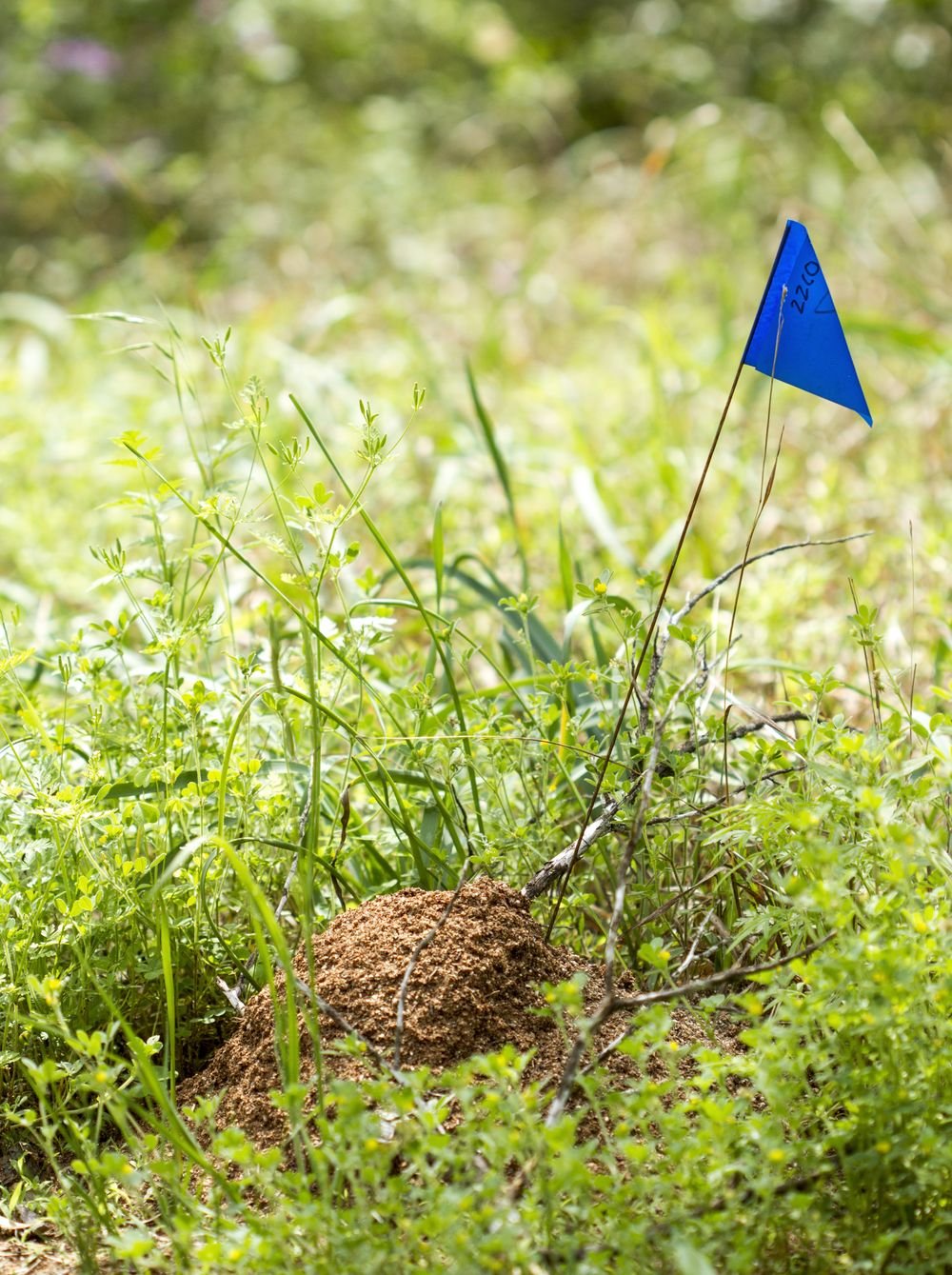
Red imported fire ants are the single most common reason a Mobile-area homeowner stops walking through their own backyard. The mounds appear practically overnight after a heavy rain, the sting is memorable, and the standard hardware-store products mostly fail to deliver lasting control. Understanding the colony biology — and the two-tier treatment approach that actually works — saves money and prevents the late-summer cycle of replacing one mound with three new ones twenty feet away.
Dealing with a pest problem right now?
📞 Call now — get matched with a licensed local exterminator: (888) 295-0220When you call, stay on the line for a few seconds while we match you with the licensed local exterminator for your area. Have your address and a quick description of the problem ready.
Licensed local pros · Fast response, subject to availability · No obligation
Why do fire ants explode on the Gulf Coast?
The red imported fire ant (Solenopsis invicta) arrived in Mobile in the 1930s aboard cargo ships from South America. The Mobile-Baldwin climate — long warm season, sandy and loamy soils, regular rainfall, and limited native ant competition — produced one of the most aggressive infestation densities in the United States. Colony density on untreated Gulf-Coast lawns commonly exceeds 200 mounds per acre, and a single mound contains 100,000 to 500,000 workers along with multiple queens in the polygyne form that dominates Mobile-area populations. That last detail matters enormously: multi-queen colonies are why hardware-store mound-drench products often fail. You kill one mound; satellite queens elsewhere on the property re-colonize the same area within weeks.
What Does Not Work — and Why
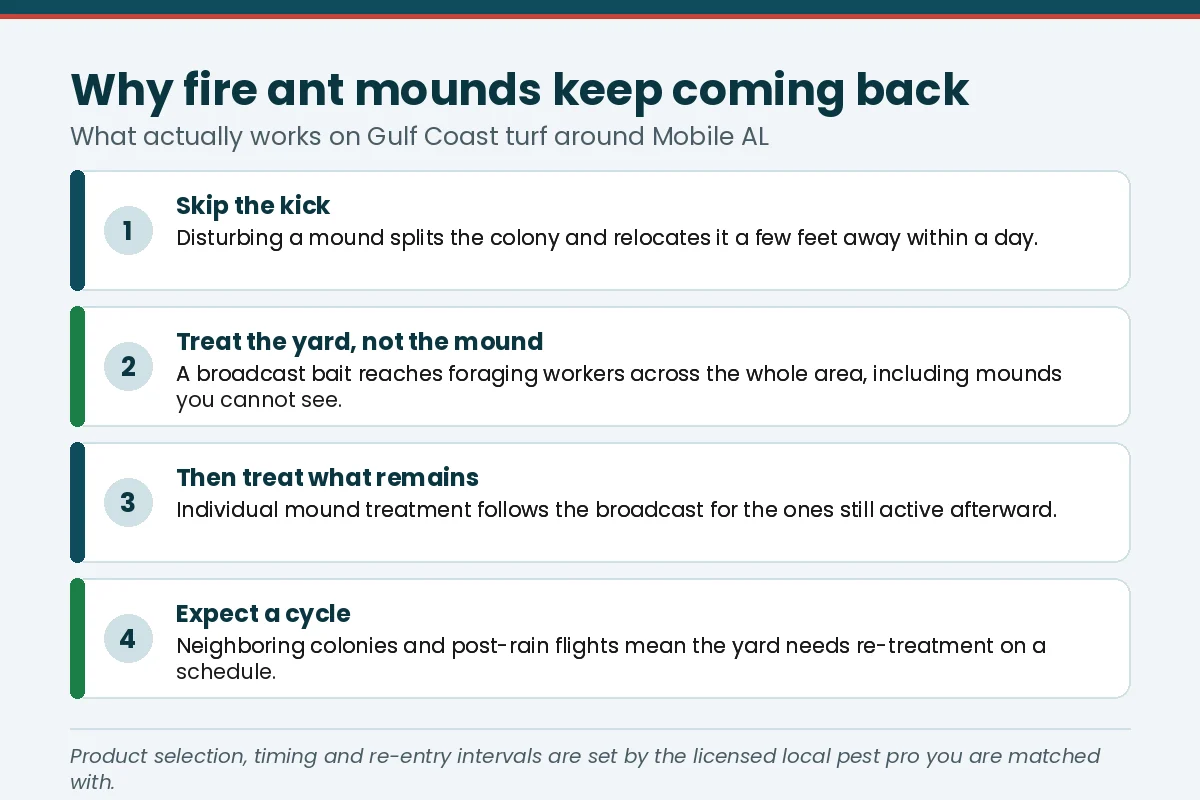
Boiling water poured on a mound kills surface ants but rarely reaches the queens 18 to 24 inches deep, and the colony usually relocates and rebuilds within a few days. Gasoline is illegal in many jurisdictions, environmentally damaging, and only partially effective. Grits, club soda, peppermint oil, and the long list of internet remedies do nothing measurable. Even legitimate single-mound drench products work on the mound you treat but ignore the rest of the property, which is how a homeowner ends up treating one mound a week all summer and still has fire ants.
The Two-Tier Approach That Actually Works
The Auburn Cooperative Extension protocol, which most licensed pest control technicians follow with minor adjustments, is a two-step combination. Step one is a property-wide broadcast bait application using a slow-acting bait that workers carry back to the colony and feed to the queens before they recognize it as toxic. Bait timing matters: apply when soil temperature is above 60°F and ants are actively foraging, which on the Gulf Coast means most of the year except the coldest weeks of January. Step two is direct mound treatment with a fast-acting insecticide on visible problem mounds — entry points near walkways, playsets, patios, and the foundation. The two together address both the colonies you can see and the satellite queens you cannot. A fire-ant mound survey is also a standard part of a broader general pest inspection, so an operator visiting for another reason will often flag mound density in the yard at the same time.
Timing on the Gulf Coast
Most coastal Alabama properties get optimal results with a spring broadcast bait in late March or April, a follow-up in early September, and direct mound treatment as new problem mounds appear through the warm months. A one-time bait broadcast on an untreated half-acre property typically reduces mound counts by 80 to 95% within four to six weeks. Maintaining that level requires ongoing treatment because the surrounding properties keep producing new mated queens that disperse by flight after rain events. Yards with heavy standing-water pressure that also draws mosquitoes sometimes combine fire ant service with a broader outdoor program; see mosquito misting systems in Mobile, AL for how that separate outdoor investment compares in cost.
Sting Response — What to Know Before Someone Is Hit
A single fire ant sting produces a sterile pustule that resolves over a week. Multiple stings — common when someone steps on a mound — produce the same pustules at every site plus a generalized inflammatory response. Anaphylaxis from fire ant venom is uncommon but documented, particularly in individuals with prior stinging-insect allergy. The standard household response: ice the area, keep it clean, do not lance the pustules. Seek emergency care for difficulty breathing, throat swelling, generalized hives, or any prior history of severe stinging-insect reaction.
Frequently Asked Questions
Are there fire ants and other ant species mixed in my yard?
Usually yes. Pavement ants, acrobat ants, and crazy ants are common in Mobile-area lawns alongside fire ants. The treatment for each is slightly different, and a property-wide protocol typically targets the dominant species while suppressing the others.
How long does property-wide fire ant treatment last?
A properly applied bait broadcast suppresses 80 to 95% of fire ant activity for two to six months. Reinvasion from surrounding properties is constant on the Gulf Coast, so maintaining suppression requires ongoing treatment one to three times per year.
Is fire ant treatment safe for pets and kids?
The bait products approved for residential use are formulated specifically with low mammalian toxicity. Standard practice is to apply and then keep pets and kids off the treated lawn until the bait granules have been carried into the mounds — usually a few hours.
Should I just hit each mound individually?
Only if you have one or two mounds. Once a property has more than a handful of mounds, single-mound treatment is the slow expensive way to do something a property-wide bait does faster and cheaper.
Get Matched With a Licensed Exterminator
One call reaches a licensed, local exterminator who covers your address — and a real person answers, 24/7.
Mobile Alabama Exterminators is a 24/7 dispatch and matching service. We connect Mobile and Baldwin County callers with licensed, insured Alabama pest control exterminators. We are not a licensed pest control company and do not inspect, treat, or warranty pest control work.